
.wwc { –wwc-primary: #3b82f6; }
The employer contribution on the termination indemnity will rise to 40% starting in 2026, changing the financial balance of this amicable separation method.
Yet, many employees and employers still fear making a procedural error that could lead to a refusal of approval by the administration. We will detail each step of the conventional termination procedure to guarantee you a secure and compliant transition.
- What is a conventional termination and who is eligible?
- How to successfully conduct negotiation interviews?
- What are the signing and withdrawal formalities?
- How to finalize administrative approval in 2026?
What is a conventional termination and who is eligible?
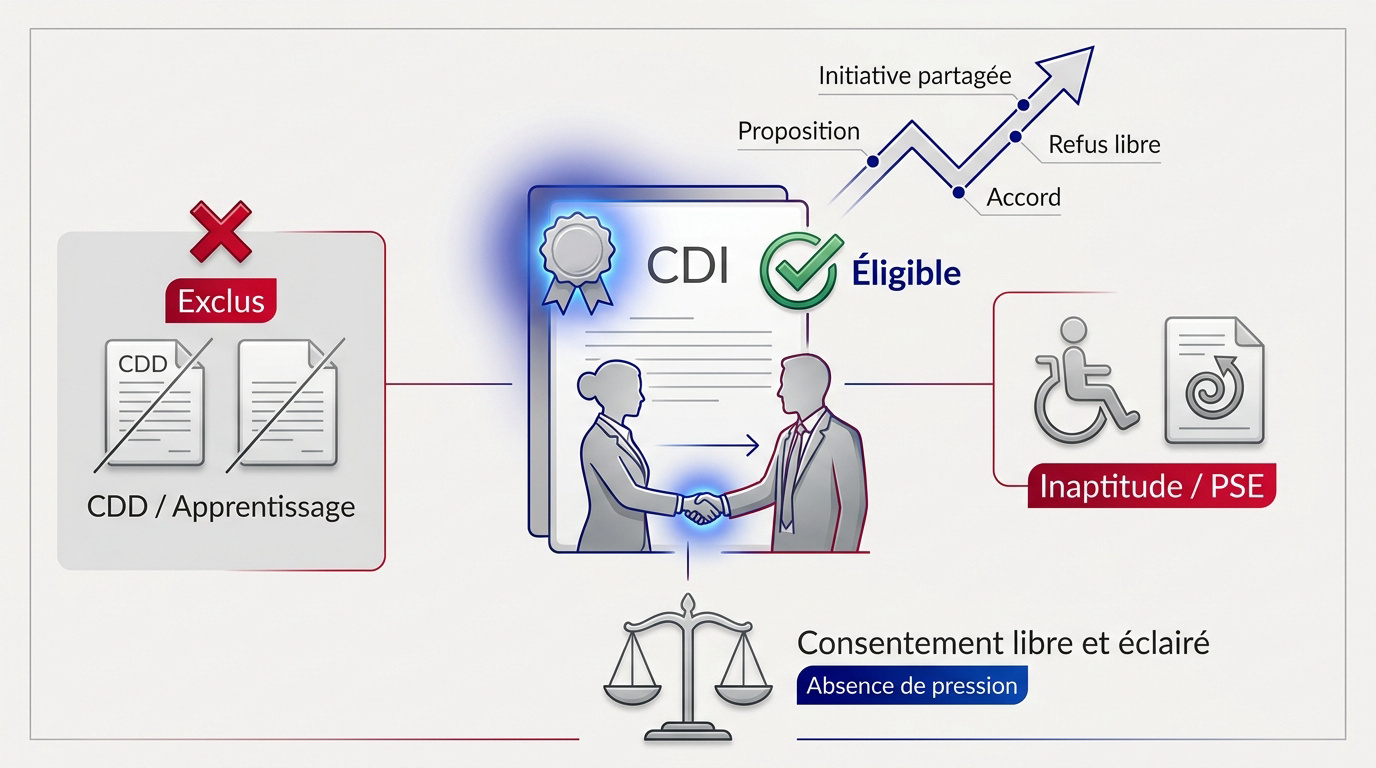
The conventional termination is reserved for permanent contracts (CDI), excluding fixed-term contracts (CDD) and apprentices. It guarantees the legal indemnity and unemployment benefits after a 15-day withdrawal period and mandatory approval. This eligibility is strictly regulated by the type of employment contract.
document.addEventListener(‘alpine:init’, () => {
Alpine.data(‘wxixa2mu7’, () => ({
step: 1,
answers: { q1: ”, q2: ”, q3: ” },
answer(key, val, next) { this.answers[key] = val; this.step = next; },
reset() { this.step = 1; this.answers = { q1: ”, q2: ”, q3: ” }; },
get diagnostic() {
if (this.answers.q1 !== ‘CDI’ || this.answers.q2 === ‘Non’ || this.answers.q3 === ‘Oui’) return “Inéligible”;
return “Éligible”;
}
}));
});
To initiate a conventional termination: the steps of the procedure in 2026, first analyze your contract.
Access conditions reserved for permanent contracts
This measure applies exclusively to permanent contracts (CDI). Fixed-term contracts (CDD) and apprentices cannot use this lever. Consent must be free, without any pressure.
Physical unfitness or a job protection plan block the procedure. Find more information on Employee Rights – Labor Inspection.
Initiative of the process and freedom to refuse
The initiative is free and shared. The employer or the employee proposes the termination without strict formalism by the Labor Code.
Anyone can refuse without justification. A refusal is never a fault. In case of deadlock, here are some alternatives:
- Request a review interview
- Propose a job adjustment
- Consider a dismissal or resignation
How to successfully conduct negotiation interviews?
Once eligibility is confirmed and a preliminary agreement obtained, the discussion phase opens to set the practical terms of departure.
Organizing exchanges and the right to assistance
Respecting the notice period is essential to organize the meeting. A minimum of five days is recommended before the first appointment. This allows for calmly preparing one’s arguments.
The employee can request a staff representative or an external advisor. This approach guarantees legal protection during the exchanges. See the benefit? It’s a significant security.
For the employee: Staff representative, company employee, or employee advisor.

For the employer: Staff member, employer union, or another employer from the sector (if < 50 employees).
If the employee is assisted, the employer can be as well. The rules vary depending on the company’s size. In fact, reciprocity ensures balanced discussions.
Key points to discuss for a balanced agreement
It is necessary to negotiate the specific termination indemnity. It cannot be less than the legal severance pay. The calculation must be precise and transparent.
Setting the contract end date remains a major step. The handover of files must be anticipated. The balance of paid leave must also be included in the calculation.
Maintaining a cordial atmosphere greatly facilitates the outcome of the conventional termination procedure. A successful negotiation often avoids resorting to the Labour Court – Labour Inspection in case of future disputes.
What are the signing and withdrawal formalities?
After reaching an agreement, the parties must formalize their agreement in writing to start the legal deadlines.
Drafting the agreement and its mandatory mentions
Draft the agreement carefully. It must state the exact amount of the indemnity. The definitive termination date is a crucial element of the document.
Provide for three original copies. One for the employee, one for the employer, and one for the administration.
“Giving an original copy to the employee is a condition for the validity of the conventional termination under penalty of nullity.”
Check the signing dates. A data entry error can lead to rejection of the approval.
Respecting the reflection period of 15 calendar days
Calculate the withdrawal period. It starts the day after signing. It is 15 calendar days, including weekends and public holidays.
15 calendar day period. Starts the day after signing. Includes Saturdays, Sundays, and public holidays.
Exercise the right of withdrawal. Simply send a registered letter with acknowledgment of receipt. No reason is required to cancel the initiated procedure.

Manage the cancellation. The employment contract then continues normally. The previous conditions remain fully applicable between the parties.
How to finalize the administrative approval in 2026?
Once the withdrawal period has elapsed, the final step is to obtain the green light from the authorities to validate the end of the contract.
Teletransmission via TéléRC and validation deadlines
Use the TéléRC portal. It is now the only way to submit the approval request. The procedure is fully digitalized for greater speed.

Monitor the processing time. The DREETS has 15 working days to respond. No response means tacit acceptance of the agreement.
Processing time of 15 working days. No response from the administration after this period means tacit approval.
Anticipate response times. For more information, see What are the response times of the labor inspection – .
Submission of mandatory documents and the impact of the social contribution
Prepare the end-of-contract documents. The France Travail certificate and the work certificate are mandatory. The receipt for full and final settlement closes the relationship.
| Fee/Contribution | Applicable rate | Recipient |
|---|---|---|
| Employer contribution | 40% | URSSAF |
| CSG/CRDS | 9.7% | URSSAF |
| Severance pay | Negotiated | Employee |
Check the portability of the health insurance. The employee retains their health coverage during their unemployment period.
The success of your mutual agreement termination depends on balanced negotiation, strict respect of the 15-day withdrawal period, and approval via TéléRC. By anticipating these key steps, you secure your severance pay and unemployment rights. Start your procedures now to calmly build your new professional future.
FAQ
Is it possible to conclude a mutual agreement termination if I am on a fixed-term contract or an apprenticeship?
No, this arrangement is strictly reserved for employees under an open-ended contract (CDI). If you are currently on a fixed-term contract or an apprenticeship contract, you cannot benefit from the mutual agreement termination to end your collaboration.
For these types of contracts, it is necessary to turn to other specific termination methods provided by the Labor Code, as the amicable mutual agreement termination procedure is legally inaccessible to them.
What are the main steps to follow to validate my mutual agreement termination?
The procedure is structured around four essential phases. It all starts with one or more negotiation meetings to set the departure conditions. Once an agreement is reached, the termination agreement is signed which formalizes the agreement.
This is followed by a mandatory 15-calendar-day withdrawal period, allowing each party to reconsider their decision. Finally, the last step is administrative approval by the DREETS, usually via the TéléRC online service, which definitively validates the end of the contract.
How is the minimum amount of severance pay calculated?
The specific severance pay cannot be less than the legal dismissal indemnity. For an employee with up to 10 years of seniority, the basic calculation is one quarter of a month’s salary per year of seniority. Beyond 10 years, the calculation is one third of a month for the additional years.
The reference salary used is the most advantageous for you between the average of the last 12 months or that of the last 3 months. Note that this is a legal minimum: you are perfectly entitled to negotiate a supra-legal indemnity during your meetings.
Can I be assisted during negotiation interviews?
Absolutely, and we recommend it to ensure balanced exchanges. As an employee, you can be assisted by a staff representative or another employee of the company. If your organization has no representatives, you can call on an external employee advisor.
Know that the employer also has this right if you decide to be assisted. They can then request a staff member or, in small companies, a member of their employer union organization.
What is the impact of the new 2026 rules on the cost for the employer?
In 2026, the financial framework changes to make the system more costly for companies. The employer’s contribution on the indemnity paid is now set at a single rate of 40%. This increase aims to more strictly regulate the use of mutual termination by raising its cost for the employer.
For you, as an employee, this means the employer might be more cautious about the overall amount of the package. However, your rights to unemployment benefits (ARE) and the minimum amount of your indemnity remain unchanged by this tax measure.
What are the deadlines to receive unemployment benefits after the end of the contract?
The opening of your rights to the Return to Employment Allowance (ARE) is not immediate. France Travail first applies a 7-day waiting period. Added to this is a specific indemnity deferral if you received an indemnity higher than the legal minimum.
This deferral is calculated based on the “above-legal” amount received and can reach a maximum of 150 days. It is therefore essential to anticipate this waiting period in your personal financial management after your contract termination.
Is the procedure different for a protected employee?
Yes, if you hold a mandate (such as a CSE member or union delegate), the procedure is reinforced. The agreement is not simply homologated by the DREETS, but must be authorized by the labor inspector.
This additional protective measure ensures that your departure is not related to the exercise of your representative functions and that your consent is truly free from any pressure from management.