
.wwc { –wwc-primary: #3b82f6; }
Beyond the legal duration of 35 hours per week, each hour worked entitles you to a wage increase of 25% or 50%, or equivalent compensatory rest. Yet, many employees still struggle to have their full actual working time recognized by their management.
Non-payment of these hours constitutes a serious breach that can jeopardize your financial situation and your health. We will help you compile a file of evidence and activate each unpaid overtime hour claim, from an amicable formal notice to referring the matter to the Labor Court.
- Legal framework and overtime pay increases
- Methods to build a solid evidence file
- How to conduct an amicable claim procedure?
- Referring the Labor Court and penalties incurred
Legal framework and overtime pay increases
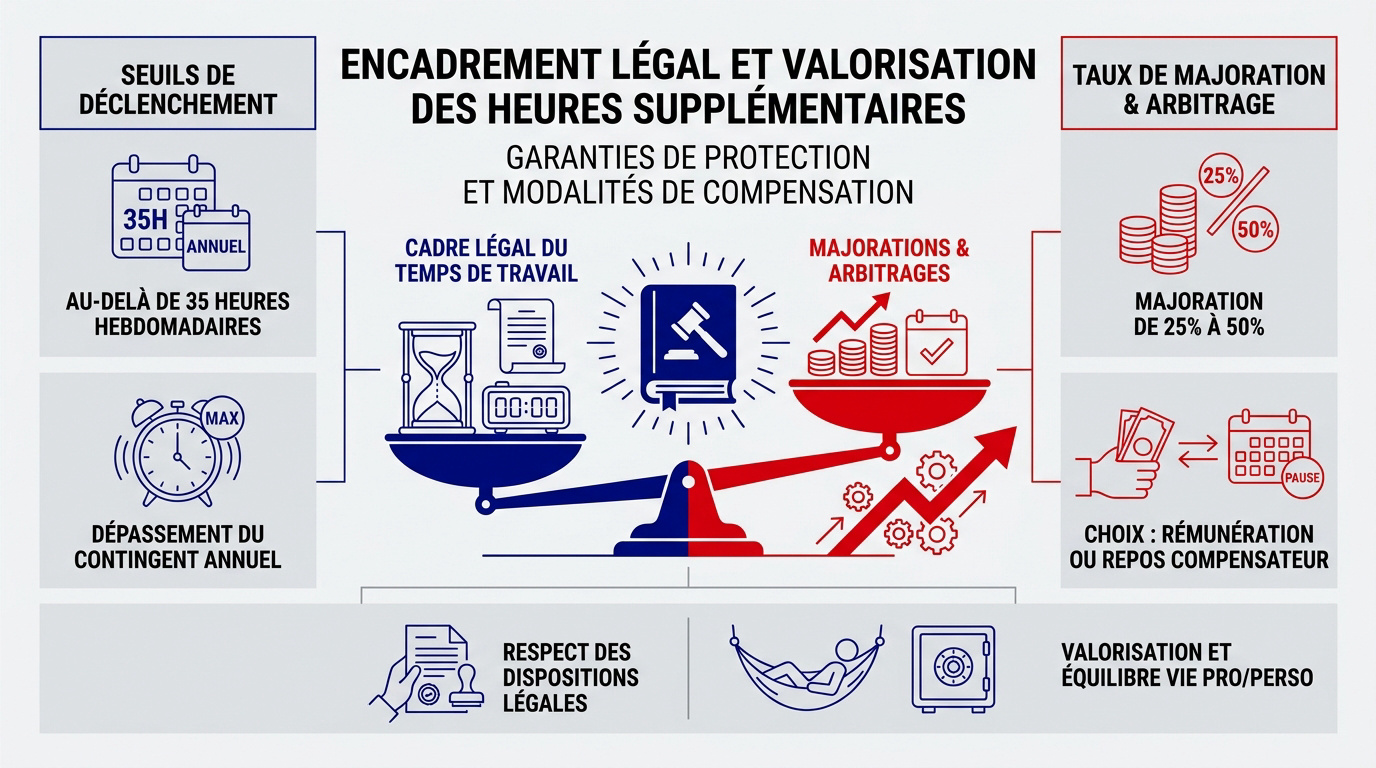
Beyond 35 hours, overtime hours are increased by 25% for the first 8 hours and 50% thereafter. The employee can claim these amounts over 3 years, proven by any means, including emails or personal calendars.
The mention of the increase rates leads directly to the details of the legal triggering thresholds.
Legal limit of 35h; 25% increase for the first 8 hours; 50% beyond; minimum of 10% via agreement.
Trigger thresholds and legal increase rates
The legal duration is set at 35 hours. The calculation is weekly. The trigger is automatic from the 36th hour worked.
The rates of 25% and 50% apply according to the volume. Company agreements may modify them without going below 10%.
Compliance with the legal working hours is imperative. Unpaid overtime: how to succeed? remains your main recourse.
document.addEventListener(‘alpine:init’, () => {
Alpine.data(‘wpzvvek3w’, () => ({
wage: 15, h25: 10, h50: 5,
get total() { return (this.wage * 1.25 * this.h25) + (this.wage * 1.50 * this.h50); },
get formattedResult() { return this.total.toLocaleString(‘fr-FR’, { style: ‘currency’, currency: ‘EUR’ }); }
}))
})
Choice between pay and compensatory rest
Compensatory rest replaces payment. It requires a collective agreement or a unilateral decision. This choice affects the payslip.
The employee receives an annexed document detailing their rights. The calculation strictly equals the classic wage increases.
Compensatory rest replaces payment for hours worked but retains the same legal overtime rates.
Methods to Build a Solid Evidence File
Once the rights are understood, you must be able to prove the work performed, especially when the company does not have automated tracking tools.
Acceptable Documents and Testimonies Without a Time Clock
To win your case, you must provide precise material evidence. Handwritten time records remain valid. Always keep emails sent early in the morning or late at night.
- Detailed personal agendas
- Telephone call logs
- Statements from colleagues or clients
- Access badge records for the parking lot
Consult resources on employee rights to secure your remuneration. These elements allow the employer to respond precisely.
Specifics of Hour Counting in Teleworking
Digital traceability becomes your best ally remotely. Connections to company servers serve as proof. Use your instant messaging histories to demonstrate real and continuous activity.
Respecting the right to disconnect limits requests outside working hours. A rigorous self-declaration is necessary. Ideally, it should be validated by a written statement from your hierarchy.
Check your working conditions to balance your domestic workload. The proof relies on a fair distribution between the parties.
Recognition of the Employer’s Tacit Agreement
Case law often recognizes the manager’s implicit agreement. If hours are worked with the knowledge and awareness of management, they are owed. The absence of formal opposition despite the overload engages the employer’s liability.
The employer has a safety obligation concerning your health. Burnout is a major risk. Monitoring working time remains an imperative and non-negotiable employer responsibility.
The employer’s lack of opposition to overtime hours they are aware of constitutes tacit agreement on their part.

How to Conduct an Amicable Claim Procedure?
Before taking the matter to court, an attempt at direct resolution with management is often preferable and legally advised.
Writing and Sending a Formal Notice
You should prioritize sending a registered letter with acknowledgment of receipt. This formality interrupts the three-year limitation period. Be sure to attach a detailed summary table listing each hour owed.
Precisely calculate the back pay and associated legal surcharges. Set a response deadline of fifteen days for your employer. Specify that failing this, you will initiate legal proceedings.
Consult this guide on implementing an individualized working hours system. Compare your records to internal agreements.
Support from the CSE and Labor Inspectorate
Request your staff representatives to initiate internal mediation. Their intervention often helps to calm the conflict quickly. They will check the conformity of the company’s time registers.
Also report the situation to the labor inspector to trigger an on-site inspection. Their report constitutes a powerful negotiation lever. It proves the employer’s serious breach.
For local contact, see the example of the labor inspectorate in Rhône. These services guide you effectively.
Taking the Labor Court and Penalties Incurred
If dialogue fails, judicial recourse becomes inevitable to obtain forced payment and sanction the employer’s breaches.
Limitation periods and calculation of back pay
The three-year limitation period allows action even after termination. This retroactive calculation obligatorily includes related paid leave.
Late payment interest is added to damages for unfair execution. These regularized amounts also improve your future retirement rights.
| Hour range | Legal increase | Salary impact |
|---|---|---|
| 36h to 43h | 25% | Financial gain |
| Beyond 43h | 50% | Strong increase |
| Compensatory rest | – | Recovery |
Criminal consequences and compensation for undeclared work
Intentional omission on the payslip results in a fixed compensation of six months’ salary. The employer is also exposed to a URSSAF adjustment for unpaid contributions.

Taking formal notice can lead to requalification as dismissal without real and serious cause. Financial penalties for the guilty company then prove massive.
See this calculation of 3300 gross to net for your estimates. Unpaid overtime: how to obtain a favorable outcome? Proof remains your main weapon.
To secure your rights, build a solid evidence file and first favor an amicable formal notice. If the deadlock persists, recourse for unpaid overtime before the labor court guarantees recovery of your wages over three years. Act now to turn your past efforts into fair compensation.
FAQ
What exactly is an overtime hour and how is it compensated?
An overtime hour corresponds to any effective working hour performed beyond the legal duration of 35 hours per week for a full-time employee. These hours entitle to a compensation which can take two forms: a salary increase or compensatory rest in lieu.
Compensatory rest allows you to convert your hours into rest time according to the same increase rate. For example, an hour increased by 25% entitles you to 1h15 of recovery. We specify that if the annual quota (often set at 220 hours) is exceeded, mandatory rest is added to the usual compensations.
How can I prove my overtime hours in the absence of a time clock?
Proof of hours worked does not rely solely on the employer; you must present sufficiently precise elements to support your claim. You can build a solid file by gathering your personal agendas, call logs, attestations from colleagues or clients, as well as your emails sent early in the morning or late at night.
In telework, digital traceability is essential. Connection logs to company servers and activity on instant messaging constitute proof of real activity. Once these elements are provided, it is up to the employer to bring their own evidence of work time control.
Does the employer have to pay for hours he did not explicitly order?
Yes, as soon as there is a tacit agreement. If your employer is aware of your overtime (via a time tracking software or late emails) and does not formally oppose it, his silence amounts to acceptance. This is also the case if the workload assigned made these hours indispensable to accomplish your tasks.
Case law considers that the employer’s lack of opposition, while being informed of the extra activity, engages his responsibility. It is up to him to reorganize your workload if he wishes to avoid the performance of these overtime hours.
What are my options if my employer refuses to pay my hours?
We advise you to initiate an amicable procedure by sending a formal notice by registered mail with acknowledgment of receipt. This letter must include a precise statement of the amounts owed. If there is no response, you can seek the support of the Works Council (CSE) or contact the labor inspectorate to attempt mediation.
If the deadlock persists, you can bring the matter before the Labor Court (Conseil de prud’hommes) to obtain back pay. Note that you have a period of 3 years to take action, even if you have already left the company. This procedure can also seek damages for unfair execution of the contract.
What penalties does a company risk for not declaring hours worked?
Listing a number of hours on the pay slip that is less than the actual hours worked can be considered undeclared work. In this situation, the employer risks paying a lump sum compensation of 6 months’ salary to the employee, not to mention the criminal penalties and the adjustment of social security contributions by the URSSAF.
Contractually, this serious breach may justify a termination of the contract attributable to the employer. If the facts are proven, the termination has the effects of a dismissal without real and serious cause, entitling the employee to additional compensation.