
.wwc { –wwc-primary: #3b82f6; }
Every year, thousands of employees take legal action to challenge a contract termination they consider unjustified. If you believe that the reasons given by your employer are not based on any specific or verifiable facts, you are probably facing an unfair dismissal for which recourse to the Labor Court allows you to obtain compensation.
We will guide you through the steps of the procedure, from the one-year limitation period to the calculation of your compensation according to the Macron scale, in order to secure your defense and assert your rights.
- What is an unfair dismissal according to the law?
- Key steps to seize the Labor Court
- The Macron scale and the calculation of termination compensation
- Strategies to optimize your defense and win your case
What is an unfair dismissal according to the law?
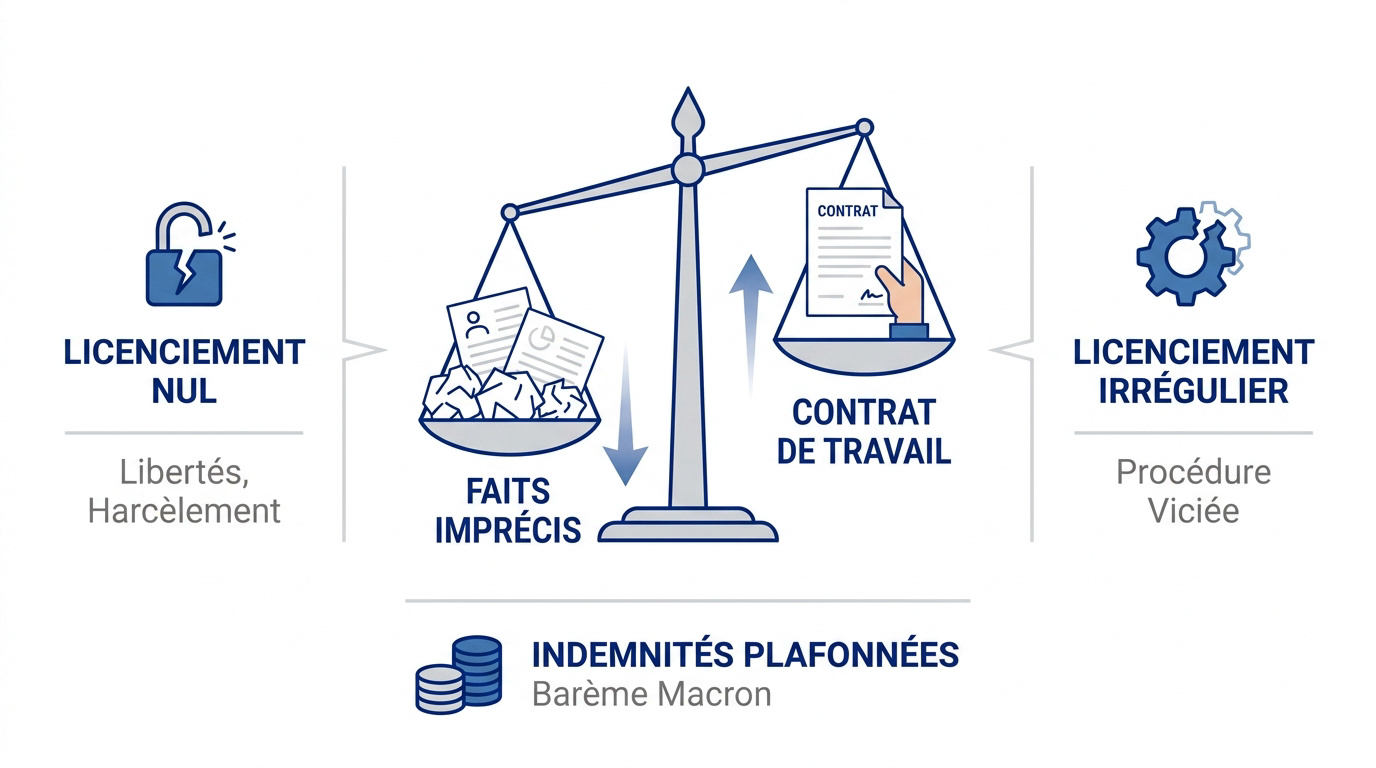
A dismissal is unfair without a real and serious cause, supported by specific and verifiable facts. The Macron scale caps compensation according to seniority, except in cases of nullity related to harassment or fundamental freedoms. Objective facts justify the termination.
Criteria for a real and serious cause
The cause must be real, existing, and accurate. It must also be serious with sufficient gravity. The facts must be objective and verifiable by the labor judges.
The dismissal letter sets the limits of the dispute. An imprecise or vague reason legally amounts to a lack of reason. This makes the termination unjustified before the courts.
The employer must provide concrete evidence of the stated reason. Doubt always benefits the employee. This rule protects fundamental rights under the Labor Code.
document.addEventListener(‘alpine:init’, () => {
Alpine.data(‘wmzpvrczx’, () => ({
step: 1,
answers: { q1: null, q2: null, q3: null },
answer(key, val) {
this.answers[key] = val;
if (this.step === 1) this.step = 2;
else if (this.step === 2) this.step = 3;
else this.step = ‘result’;
},
reset() {
this.step = 1;
this.answers = { q1: null, q2: null, q3: null };
},
get resultTitle() {
if (this.answers.q1 === ‘Oui’) return “Licenciement potentiellement NUL”;
if (this.answers.q2 === ‘Non’) return “Licenciement potentiellement IRRÉGULIER”;
if (this.answers.q3 === ‘Non’) return “Licenciement potentiellement ABUSIF”;
return “Licenciement a priori VALABLE”;
},
get resultDescription() {
if (this.answers.q1 === ‘Oui’) return “Il s’agit d’une violation grave des droits du salarié. Le barème Macron n’est pas applicable et une réintégration dans l’entreprise peut être demandée.”;
if (this.answers.q2 === ‘Non’) return “Il s’agit d’un vice de forme dans la procédure. Cela donne droit à une indemnité spécifique (maximum 1 mois de salaire), même si le motif de fond est valable.”;
if (this.answers.q3 === ‘Non’) return “Le licenciement est considéré comme sans cause réelle et sérieuse. Vous pouvez prétendre à des dommages et intérêts dont le montant est encadré par le barème Macron.”;
return “Le licenciement semble respecter les critères légaux sur la forme et sur le fond. Toutefois, seul un examen détaillé de votre dossier par un avocat pourra confirmer cette analyse.”;
}
}));
});
Differences between unfair, null, and irregular dismissal
Null dismissal penalizes the violation of fundamental freedoms. It allows to exclude the compensation caps of the Macron scale, protecting the employee who is a victim of discrimination or harassment.
Irregular dismissal concerns a procedural defect. The preliminary interview was poorly conducted or the legal deadlines were not respected by the employer during the termination.
A null dismissal can lead to the mandatory reinstatement of the employee, unlike unfair dismissal which often results in simple financial compensation.
To initiate a claim, study each step of the dismissal. These legal distinctions directly determine the amount of compensation awarded by the judge.
Key steps to seize the Labour Court
Once the unfair nature is suspected, you must act quickly to bring the case before the labour court.
Legal deadlines and drafting the application
The limitation period is twelve months. This period starts from the notification of the termination of the employment contract. Do not delay.
The application must be precise. It contains the identity of the parties and the quantified claims. A specific Cerfa form is available to facilitate this administrative procedure.
To succeed in your unfair dismissal claim: your appeals before the labour courts, consult the missions of the Labour Court. This support is valuable for your case.
- Check the 12-month deadline.
- Draft the Cerfa application with quantified claims.
- Attend the mandatory conciliation (BCO).
- Proceed to the judgment chamber if no agreement is reached.
The mandatory conciliation phase
The Conciliation and Orientation Office (BCO) is the first step. The judges try to find an amicable agreement to avoid a long trial.

The lump-sum conciliation allowance is an advantage. It is exempt from social charges within certain limits. It is a quick solution to receive your funds without waiting.
- Speed of payment.
- Immediate end to the dispute.
- Favorable taxation of the lump-sum allowance.
The conciliation allowance is often exempt from income tax and social charges within the legal limits set by the scale.
The Macron scale and the calculation of termination indemnities
If conciliation fails, the judge will apply the legal compensation grids to determine the amount of damages.
Calculation of damages according to seniority
The Macron scale sets minimums and maximums. These amounts strictly depend on the employee’s seniority at the time of their departure from the company. The judge must respect these legal limits.
The size of the company impacts the minimum amount. In structures with fewer than eleven employees, the minimums are reduced for the first years of seniority. This limits the financial burden for very small businesses.
| Seniority (years) | Minimum indemnity (months) | Maximum indemnity (months) |
|---|---|---|
| 1 year | 1 month | 2 months |
| 2 years | 3 months | 3.5 months |
| 5 years | 3 months | 6 months |
| 10 years | 3 months | 10 months |
| 20 years | 3 months | 15.5 months |
| 30 years | 3 months | 20 months |
Possible accumulation with other legal indemnities
Damages are added to the usual indemnities. You always receive your severance pay, paid leave, and notice period, except in cases of gross misconduct. These amounts are due as a matter of right.
A separate moral prejudice can be invoked. This happens if the circumstances of the termination are humiliating or harsh. The judge can then award an additional sum. This compensation is independent of unfair dismissal: your appeals before the labor courts.
We advise you to consult the Labor Code to verify your rights. These rules apply to all contracts.

Strategies to optimize your defense and win your case
Succeeding in your trial requires rigorous preparation and appropriate support to assert your rights.
Assistance by a lawyer or a union defender
The lawyer offers sharp technical expertise. He masters the subtleties of case law. It is a often necessary investment for complex or high-stakes cases.
The union defender is a free alternative. He intervenes voluntarily to assist employees. His field experience is a major asset during pleadings.

We advise you to consult a labor law lawyer to secure your procedure. This legal assistance guarantees a precise analysis of your personal situation.
The question of reinstatement in the company
Reinstatement is rarely imposed by the judge. It is proposed if the dismissal is without real cause. Both parties generally must agree.
Reintegration requires the agreement of both parties, unless the dismissal is declared null and void, then becoming a right for the employee.
In case of refusal, the employee receives their usual compensation. If the dismissal is null, reintegration is a right. The employer cannot easily oppose it. The judge ensures compliance with this rule.
Reintegration involves payment of lost wages between the dismissal and the actual return to the workforce.
Acting quickly allows you to effectively challenge a dismissal without real and serious cause before the one-year deadline. By favoring conciliation or the judgment office, you secure your compensation according to the Macron scale. Prepare your evidence now to obtain compensation and calmly consider your professional future.
FAQ
What precisely defines an unfair dismissal according to the legislation?
An unfair dismissal is one without real and serious cause when the reason invoked by the employer to terminate the employment contract is not based on precise, verifiable, and sufficiently serious facts. To be valid, the termination must be based on a real cause, that is, existing and accurate, as well as on a serious cause making it impossible to keep the employee in the company.
If the labor tribunal considers that these criteria are not met, it can invalidate the employer’s decision. We specify that doubt generally benefits the employee and that the absence of a precise reason in the dismissal letter is enough to render the termination unfair in the eyes of the judges.
What is the deadline to contest my dismissal before the labor tribunal?
If you wish to challenge the validity of your dismissal, you have a twelve-month period from the notification of the termination of your contract. This limitation period is strictly regulated; it is therefore essential to act quickly to prepare your claim and seize the competent jurisdiction.
The procedure begins with the filing of a petition specifying your quantified demands. We remind you that a mandatory conciliation phase is systematically organized before any substantive judgment, in order to try to resolve the dispute by an amicable agreement between the parties.
How are compensation amounts calculated in the case of dismissal without real and serious cause?
The amount of damages is governed by the Macron scale, which defines minimum and maximum compensation limits. This calculation is based on two main criteria: your seniority in the company at the time of departure and the total workforce of the company (more or less than eleven employees).
These labor tribunal compensations are added to amounts already received, such as the legal dismissal indemnity, the compensatory notice indemnity, and paid leave indemnity. Note that these damages are not subject to income tax and benefit from social contribution exemptions under certain conditions.
What are the major differences between an unfair dismissal and a null dismissal?
An unfair dismissal concerns the absence of a valid reason, while a null dismissal sanctions a serious violation of the law or fundamental freedoms, such as discrimination or harassment. In the case of a null dismissal, the Macron scale does not apply, allowing the judge to grant much higher compensation, often exceeding six months’ salary.
Another fundamental distinction lies in reintegration: if it is optional and subject to the agreement of both parties for an unfair dismissal, it becomes a right for the employee in case of nullity. The employer cannot oppose it, and the employee may claim payment of lost wages during the exclusion period.
Is it mandatory to be assisted by a lawyer during a labor tribunal procedure?
Assistance by a lawyer is not mandatory before the Labor Tribunal. You have the option to defend yourself or to be represented by your spouse, a colleague from the company, or a union representative. The latter offers free support and valuable practical expertise for employees.
However, we often recommend consulting a lawyer specialized in labor law for complex cases. Their technical expertise allows them to master the subtleties of case law and maximize your chances of obtaining full compensation for your damage before the judging panel.