
.wwc { –wwc-primary: #3b82f6; }
In France, the law punishes moral harassment regardless of any hierarchical link or the perpetrator’s intent to harm. These repeated actions degrade your working conditions and seriously affect your dignity as well as your health. Faced with this drift, it is common to feel isolated and helpless in legally qualifying the facts experienced.
We will guide you to identify possible remedies and understand concretely what to do in the face of moral harassment at work to protect your rights and your professional future.
- Recognize moral harassment at work: what to do when faced with the signs?
- 5 types of evidence to validate your legal file
- How to alert internal bodies without putting yourself at risk?
- Legal remedies and protection against unfair dismissal
Recognize moral harassment at work: what to do when faced with the signs?
Moral harassment requires the repetition of actions degrading working conditions, harming dignity or health. The proof relies on a body of evidence such as writings or testimonies, facilitating the recognition of legal criteria.
Repeated actions, degradation of working conditions, damage to dignity and health deterioration.
To address this issue, it is necessary to identify the constitutive elements defined by the Labor Code.
The legal criteria defining repeated actions
The law requires the repetition of acts to characterize harassment. No minimum duration is imposed by the texts. Two incidents can sometimes be legally sufficient.
These actions must cause a degradation of working conditions. This is manifested by a deterioration of the employee’s physical or mental health.
The harm to dignity is central. This criterion is essential to characterize the offense.
Concrete examples between rigid management and abusive drift
One must distinguish the power of direction from abuse. A manager can criticize work. However, public humiliation crosses the legal line.
Being sidelined is a major warning sign. Isolation and withdrawal of tasks constitute alerts.
Consult our guides on moral harassment at work or how to react in case of degradation of working conditions.
document.addEventListener(‘alpine:init’, () => {
Alpine.data(‘w44wqo8ks’, () => ({
step: 1,
answers: { q1: ”, q2: ” },
answer(key, val, next) { this.answers[key] = val; this.step = next; },
reset() { this.step = 1; this.answers = { q1: ”, q2: ” }; },
get resultType() {
if (this.answers.q1 === ‘Non’) return ‘INFO_ISOLE’;
if (this.answers.q1 === ‘Oui’ && this.answers.q2 === ‘Oui’) return ‘ALERTE’;
return ‘VIGILANCE’;
},
get resultTitle() {
const titles = { ‘INFO_ISOLE’: ‘Fait isolé’, ‘ALERTE’: ‘Alerte’, ‘VIGILANCE’: ‘Vigilance’ };
return titles[this.resultType] || ”;
},
get resultDescription() {
const descriptions = {
‘INFO_ISOLE’: ‘Le harcèlement nécessite une répétition.’,
‘ALERTE’: ‘Les critères légaux semblent réunis.’,
‘VIGILANCE’: ‘La répétition est présente, soyez vigilant.’
};
return descriptions[this.resultType] || ”;
},
get resultClass() { return this.resultType === ‘ALERTE’ ? ‘wwc wwc-zap’ : ‘wwc wwc-info’; }
}))
})
Health consequences and recognition of burnout
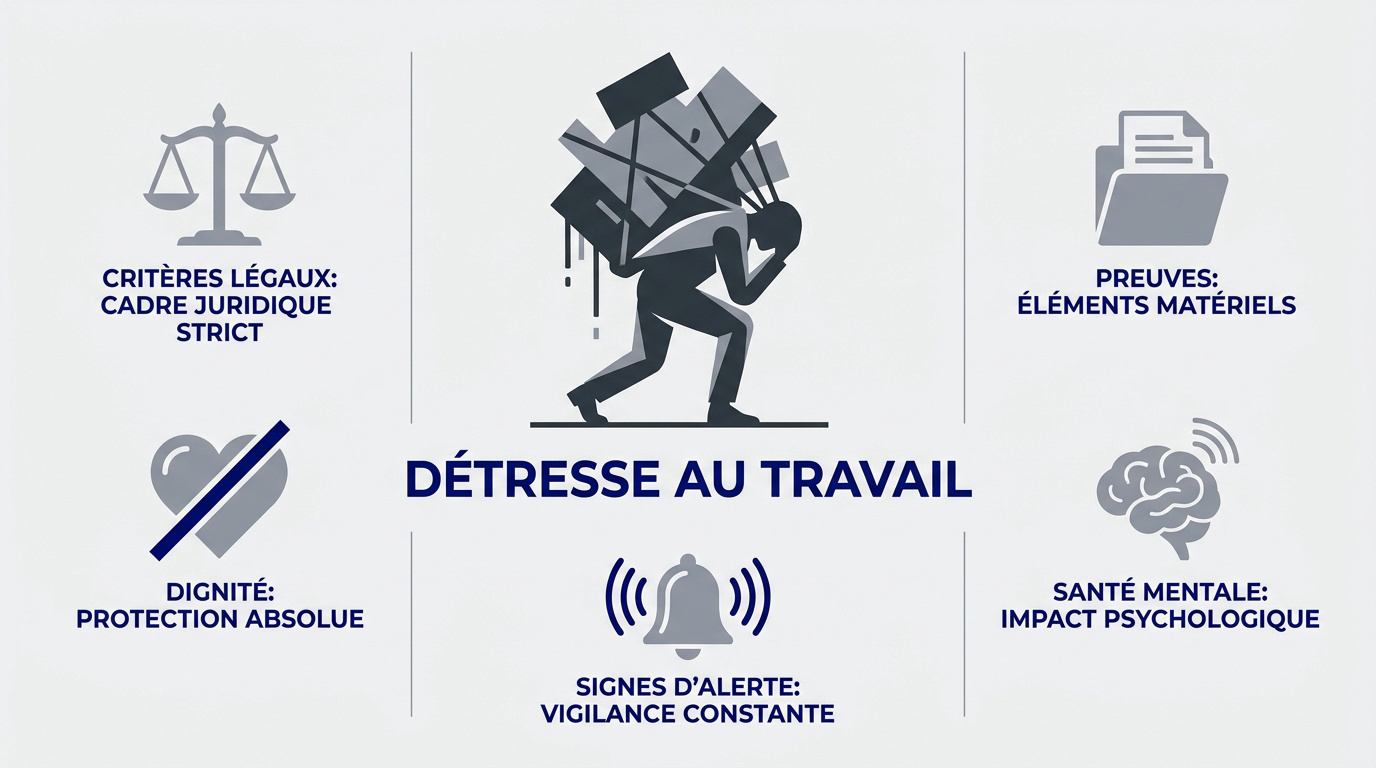
Moral harassment at work: how to react effectively? The psychological impact is profound. The employee suffers from anxiety. These symptoms reveal real suffering for which a causal link must be established.
Burnout can be recognized as an occupational disease. A 25% incapacity is required. The doctor’s opinion is crucial here.
5 types of evidence to validate your legal file
Once the signs are identified, the absolute priority becomes the building of a solid file to support your accusations before the competent authorities.
The legal value of writings, SMS, and recordings
Systematically archive aggressive emails and SMS. Instant messaging apps like WhatsApp also serve as material evidence. These digital elements constitute the foundation of your file.
The Court of Cassation now accepts certain clandestine recordings. They must be strictly necessary for the exercise of your rights. However, be cautious about the proportionate use of this risky method.
Evidence is free in matters of moral harassment, but it must remain fair so as not to backfire against the employee.
The role of testimonies and medical certificates
Requesting attestations from colleagues is a major step. Use the official Cerfa form to guarantee validity. These testimonies significantly strengthen credibility.

The attending physician records the evolution of your health status. These documents allow precise dating of the start of the actions suffered. They objectify the real impact of harassment.
Note each fact, date, and time in a logbook. This personal document helps to structure your factual chronology.
Moral harassment at work: how to react effectively? Inform yourself about employee rights to act with confidence.
Use Cerfa forms, keep a dated logbook, and archive your SMS or WhatsApp exchanges.
How to alert internal bodies without putting yourself at risk?
Gathering evidence is a crucial step, but knowing who to turn to within the company often allows you to stop the spiral before total exhaustion.
Contacting the employer and the harassment referent of the CSE
Formalize the alert by registered mail. This procedure activates the employer’s safety obligation. They must then protect your health and initiate an internal investigation.

Moral harassment at work: how to react effectively? involves these key actors:
- Role of the harassment referent
- Referral to the elected representatives of the CSE
- Triggering the alert procedure
- Protection of victims
Internal: Employer, CSE, Occupational doctor.
External: Labor inspectorate, Unions, Defender of rights.
The intervention of occupational medicine and inspection
Request a spontaneous medical visit. The occupational doctor can recommend workstation adjustments. Their role is to note unfitness if continuation is impossible.
To obtain external support, you can contact the labor inspectorate quickly. It is also useful to know how to alert the labor inspectorate to report any safety violations.
Mediation as an alternative to resolve the conflict
Propose professional mediation. A neutral third party helps restore broken communication. This amicable route sometimes avoids judicial proceedings.
Consider a secured mutual termination. If dialogue fails, negotiating your departure remains an option to preserve your future.
Mediation is a right that each party can request to ease tensions.
Judicial recourse and protection against unfair dismissal
Despite attempts at internal resolution, legal action sometimes stands as the only safeguard to obtain compensation and sanction abuses of power.
Action before the Labor Court and deadlines
Holding the company liable allows you to claim damages. The limitation period to act is set at five years. This process aims to compensate for the harm suffered.
Nullity of dismissal can be obtained if the dismissal results from a report. Reinstatement then becomes possible. Judges firmly protect the freedom of expression of the victimized employee.
Filing a criminal complaint against the perpetrator
Filing a complaint for harassment is a right. The perpetrator risks two years in prison and a 30,000 euro fine. This procedure targets directly the individual responsible for the acts.
| Sanction | Penalty | Limitation period |
|---|---|---|
| Criminal | €30,000 / 2 years | 6 years |
| Civil | Damages | 5 years |
Protection against dismissal and retaliation
Whistleblower immunity guarantees that no employee can be sanctioned for a good faith testimony. The law prohibits any subsequent discriminatory measure against the victim.
Any disciplinary sanction taken following a denunciation is null. For Moral harassment at work: how to react effectively?, it is useful to report your employer to the labor inspectorate.
Faced with moral harassment at work, what to do to protect your health and career? By collecting tangible evidence and alerting the competent authorities, you activate powerful legal levers to obtain compensation. Act today to turn this ordeal into a new serene professional start.
FAQ
What legally characterizes moral harassment at work?
Moral harassment is defined by the repetition of hostile acts that have the purpose or effect of deteriorating the employee’s working conditions. These acts must be likely to infringe on their rights and dignity, harm their physical or mental health, or jeopardize their professional future.
It is important to note that the law does not require a minimum duration to establish repetition; two distinct incidents may be sufficient to characterize the offense. Furthermore, harassment is constituted even if the perpetrator did not have the deliberate intention to harm, as long as the consequences for the victim are proven.
What types of evidence can I gather to build my case?
In matters of harassment, evidence is unrestricted. We advise you to systematically collect all factual and dated elements: aggressive emails, SMS, screenshots of instant messaging, or testimonies from colleagues via the official Cerfa form. Medical certificates are also essential to date the impact of the acts on your health.
Regarding clandestine recordings, the 2024 case law now admits their admissibility under strict conditions. The recording must be indispensable for exercising your rights and the intrusion into the other party’s private life must remain proportionate to the intended purpose. However, we recommend caution in using this method.
Which bodies should I contact to report my situation?
Within the company, you must inform your employer, preferably by registered mail, to trigger their safety obligation. You can also contact the harassment referent of the CSE or staff delegates who have a right of alert. The occupational physician remains a privileged interlocutor, bound by professional secrecy, to note the deterioration of your health.
Outside the company, the labor inspectorate can intervene to verify compliance with safety rules. If you believe the harassment is linked to discrimination, the Defender of Rights can be seized. Finally, specialized associations and unions can support you in your mediation or appeal procedures.
Can burnout be recognized as an occupational disease?
Although there is no specific table for psychological disorders, burnout can be recognized as an “off-table” occupational disease. For this, it must be established that the disorder is essentially and directly caused by work and that it results in a permanent partial disability (IPP) of at least 25%.
The process requires the opinion of a regional committee for the recognition of occupational diseases (CRRMP). Once recognized, you can benefit from increased daily allowances and full coverage of medical expenses related to your condition.
What judicial remedies and sanctions can the perpetrator face?
You have a 5-year period to bring a case before the Labor Court to obtain damages or request the annulment of a dismissal related to harassment. On the criminal level, the time limit to file a complaint is 6 years. Moral harassment is an offense punishable by 2 years imprisonment and a fine of 30,000 euros.
Know that the law protects you against any form of retaliation. No employee can be sanctioned, dismissed, or subjected to discriminatory measures for having testified or reported acts of moral harassment suffered in good faith.