
In summary for those who don’t have time to read everything
If your taxable income is below a certain threshold, the State may cover part or all of your legal fees through legal aid. To benefit from it, submit an application to the legal aid offices in your region, providing the necessary supporting documents. Legal aid covers various costs, such as lawyer fees or expert fees. Eligibility criteria depend notably on your assets and income. If you are in conflict with your employer, a labor law lawyer can also be helpful. To start the procedure, obtain the CERFA form No. 15626 * 01 at the town hall or court.
The State could cover certain costs related to legal proceedings, in the event that your taxable income is below the reference value, or when the value of your assets is below certain thresholds (real estate and personal property). The State will then grant you total or partial legal assistance.
To enjoy this option, please make a written or printed request to the legal aid offices near you, you must also provide proof before or supporting documents after the start of the process. The information we provide here refers to recent applications in effect since the beginning of this year, that is, January 1st.
Have you already contacted the labor inspection of your region without success? The labor inspector of your city advises you to contact a labor law lawyer or the legal aid office in your city to defend yourself or file a complaint against your employer.
What is legal aid?
By definition, the aid provided by the State is called legal aid when it concerns assistance for the costs of any judicial procedure. Those entitled to this aid are those whose taxable income is below (certain maximum limits defined by legislation).
Therefore, you may benefit from partial assistance or full legal assistance. However, to benefit from these privileges, you must first initiate an assistance request procedure at the legal offices of your district. Supporting documents must still be provided during or shortly before the procedure.
So why legal aid? In fact, it is intended for people who really want their legal rights to be upheld. The problem is that these people cannot afford to pay the costs related to legal proceedings. Here are some examples of legal costs:
- Payment of incidental fees for lawyers, bailiffs, notaries, etc., also called judicial officers.
- Payment of fees related to judge’s orders, such as an expert report or an investigation.
Know that you have the right to request legal aid regardless of your role in the judicial process in question. Thus, all types: witness, defendant, respondent or civil party can aspire to be assisted, the main condition being compliance with the concession conditions. All that remains is to wait for partial or total aid.
How to qualify for legal aid?
As we said above, you must take into account certain ceilings especially concerning movable assets, real estate assets, and reported taxable income. For full legal aid, the ceiling values are:
- Amount of real estate assets: 49,781 euros
- Carryover taxable income: 16,596 euros
- Amount of movable assets: 16,596 euros
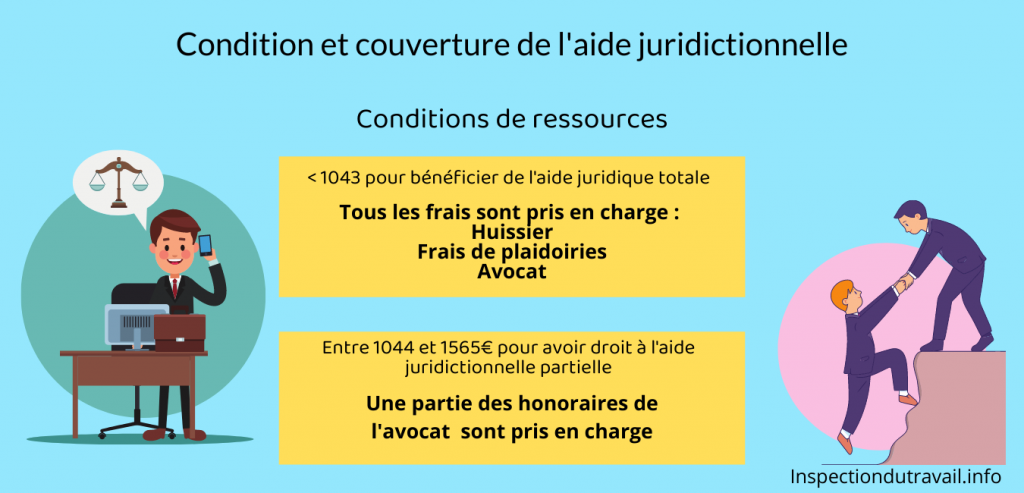
There is also an opportunity to benefit from legal aid, especially if you have no dependents and have resources below 1043 euros. Thus, the state will cover all your legal fees. Furthermore, if you have an income between 1044 and 1565 euros per month and have no dependents, you will receive partial legal aid.

What is the timeframe to obtain legal aid?
The timeframe can sometimes be long and may take several weeks, yet sometimes the situation with your employer is tense and not knowing the timeframe for obtaining or the right to legal aid can be frustrating…
We have already had friends in our circle in this situation, and it turns out that sometimes the help of a labor law attorney who charges fixed fees plus a percentage of the case can be quite interesting from an economic point of view.
Where to obtain a legal aid application form?
The application form in question is called CERFA N° 15626 * 01. It is a form to be collected at the town hall or the court. If you benefit from legal protection accredited by a contract that does not cover procedural costs, you must add a certificate of non-coverage to the files. Legal assistance is effective in cases where you have a procedure before a labor tribunal.
However, the files must first be submitted to the court of first instance. To do this, you must contact a lawyer in charge of the free legal aid procedure so that you can receive assistance in all steps. Their fees are not paid in advance but are linked to fee arrangements and various payment methods.
Where to go to apply for legal aid?
If there is not yet an emergency judge, know that you must contact the judicial aid office to submit the said file; it is the office of the high court. Otherwise, you will use a legal aid office designated by the judge.
On the other hand, be careful not to contest a decision of the magistrate and the administration; only the registry of the relevant administrative court should be effective. If the decision does not suit you, you must appeal; this is done in the same offices but this time before the Court of Appeal.
- You also have the option to send your application by registered letter with acknowledgment of receipt.
- However, we advise you to make a direct submission to a legal aid office of the court of first instance because in this case your file will be received and you will have a receipt with a file number.
When you cannot afford to pay a lawyer, you may be entitled to free legal aid and thus benefit from several lawyers to choose from or a court-appointed lawyer chosen by the president of the bar association. However, if you are involved in a labor-related legal procedure and lose, the aid does not cover damages.
The timeframe to obtain legal aid is governed by the duration of the case review. In fact, it takes between 15 days and 6 months to receive a significant response. Additionally, it is the legal aid office of the court of first instance that informs you about the progress of the application.
Full legal assistance is only granted to people whose income is below 1043 euros. However, partial legal assistance is intended for people with income between 1044 and 1565 euros.